High Commission of the Democratic Socialist Republic of Sri Lanka – New Zealand

Loading
Loading
Text Size
Font Family
Text Spacing
Zoom
Accessibility by Econsulate
© 2026 Econsulate
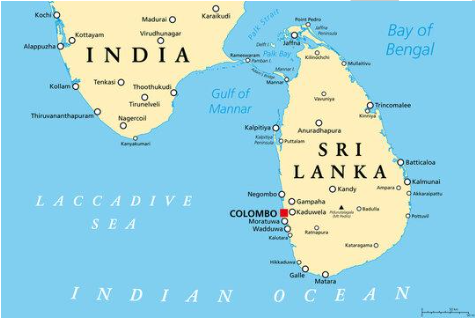
Set in the Indian Ocean in South Asia, the tropical island nation of Sri Lanka has a history dating back to the birth of time. It is a place where the original soul of Buddhism still flourishes and where nature’s beauty remains abundant and unspoilt.
Few places in the world can offer the traveller such a remarkable combination of stunning landscapes, pristine beaches, captivating cultural heritage and unique experiences within such a compact location. Within a mere area of 65,610 kilometres lie 8 UNESCO World Heritage Sites, 1,330 kilometres of coastline – much of its pristine beach – 15 national parks showcasing an abundance of wildlife, nearly 500,000 acres of lush tea estates, 250 acres of botanical gardens, 350 waterfalls, 25,000 water bodies, to a culture that extends back to over 2,500 years.
This is an island of magical proportions, once known as Taprobane, Serendib, the Pearl of the Indian Ocean, and Ceylon. Discover refreshingly Sri Lanka!
The economy is transitioning from a predominantly rural-based economy towards a more urbanized economy oriented around manufacturing and services. The country has made significant progress in its socio-economic and human development indicators. Social indicators rank among the highest in South Asia and compare favorably with those in middle-income countries.
| Conventional long form | Democratic Socialist Republic of Sri Lanka |
|---|---|
| Conventional short form | Sri Lanka |
| Former | Ceylon |
| Government Type | Republic |
| Independence | 04 February 1948 |
| Location | An island off the south-eastern cost shores of India, 880 km north of the equator, in the Indian Ocean. It lies between 5° 55′ and 9° 55′ north of the equator and between the eastern longitudes 79° 42′ and 81° 52′. |
| Dimensions | 430 km North to South, 225 km East to West |
| Area | 65,610 square km |
| Terrain | Mostly low, flat to rolling plain; mountains in south-central interior |
| Climate & Seasons | In the lowlands the climate is typically tropical with an average temperature of 27°C in Colombo. In the higher elevations it can be quite cool with temperatures going down to 16°C at an altitude of nearly 2,000 metres. Bright, sunny warm days are the rule and are common even during the height of the monsoon – climatically Sri Lanka has no off season. The south west monsoon brings rain mainly from May to July to the western, southern and central regions of the island, while the north-east monsoon rains occur in the northern and eastern regions in December and January. |
| Highest Mountain | Pidurutalagala, 2,524 m |
| Highest Waterfall | Bambarakanda, 263 m |
| Population | 21.78 Million (2024 Census)51.7% Female48.3% Male |
| Population Growth Rate | 0.52 (2025) |
| Population Density | 309 people per sq km |
| Life Expectancy at Birth | 76.4 female, 71.7 male (2001 est) |
| Literacy Rate | 92.7 % (2003 est) |
| Ethnic Groups | Sinhalese 74%, Sri Lankan Tamil 12.3%, Sri Lankan Moors 10.5%, Indian Tamil 2.7%, other 0.5% (2025) |
| Languages | Sinhala (official language) 74%, Tamil (official language) 18%, other 8%Note: English (commonly the link language) is used in government and spoken competently by about 10% of the population. (2025) |
| Religion | Buddhist (official) 69.8%, Hindu 12.6%, Islam 10.7%, Roman Catholic 5.6%, other Christian 1.3%, other 0.05% (2025) |
| Currency (code) | Sri Lankan Rupee (LKR) |
| Time Zone | Sri Lanka Standard Time is five and a half hours ahead of GMT (+5.30 GMT) |
| International Dialling | +94 |
| Electricity | 230 - 240 volts, 50 cycles AC |
| Gross Domestic Product (GDP) | (Purchasing Power Parity): $426.6 billion (2024) |
| Gross Domestic Product (GDP) | $87.35 billion (2024) |
| Gross Domestic Product (GDP) | Real growth rate: 5.4% (2024) |
| Agricultural products | Tea, rubber, coconut-based products, rice, sugarcane, grains, pulses, oilseed, spices, vegetables, fruit; milk, eggs and fish |
| Industries and Services | Apparel, Processing of rubber, tea, coconuts, tobacco and other agricultural commodities; telecommunications, insurance, banking; tourism, shipping; clothing, textiles; cement, petroleum refining, information technology services, construction |
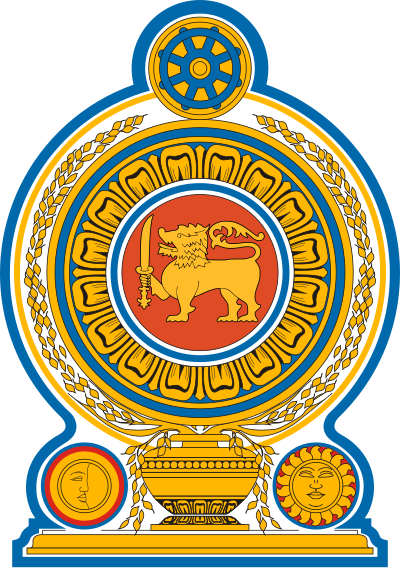
The National Emblem of Sri Lanka was adopted in 1972. It features a golden lion in the centre, surrounded by petals of gold representing the blue lotus flower.
The base of the emblem is a traditional grain vase sprouting sheaves of rice. Sinhalese heraldic symbols of the sun and moon flank either side of the vase, and the crest of the Dharmachakra at the top represents Buddhism.
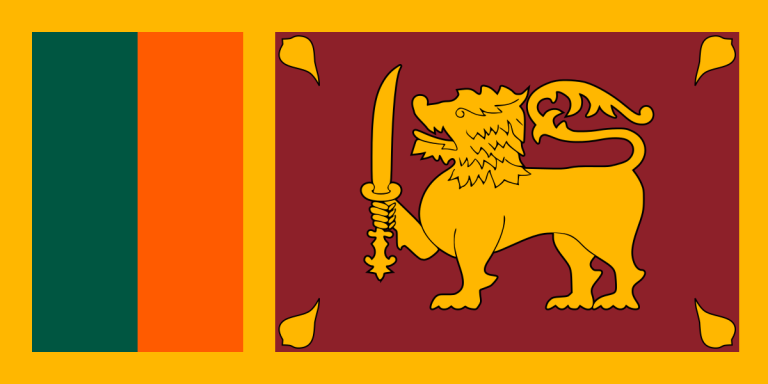
The National Flag of Sri Lanka represents the country and her heritage as rallying device that integrates all communities with the majority.
Sri Lanka National Flag is an improvisation of the civil standard of the last king of Sri Lanka, Sri Wickrama Rajasingha.
The civil standard had a passant royal lion with a sword in its right forepaw at the centre, and a bo-leaves on each of the four corners on a plain border.
When Sri Lanka gained its independence from Great Britain on February 04, 1948, it was the lion flag of the last king of Sri Lanka was hoisted once again.
The first Prime Minister of independent Sri Lanka, D.S. Senanayake, appointed a committee to advice the government on the design of a new national flag. The design approved by the committee in February 1950 retained the symbol of the lion with the sword and the bo-leaves from the civil standard of the last king of Sri Lanka, with the inclusion of two vertical stripes green and orange in colour.
The national flag was hoisted for the first time on March 3, 1950.